Kristin Patterson - Accessibility Program Leader, UX Strategist
Accessibility is product quality.
I build accessibility programs that ship - and keep working after launch, because the interesting accessibility work doesn't happen at launch. The measure isn't a passed audit. It's more customers completing more journeys, and a team that knows how to keep it that way.
At Bottle Rocket, Cariloop, and Alto, I brought accessibility into companies that didn't have it - three different ways: a program designed from scratch, a company-wide product transformation, and embedding it in the everyday work. At Hilton, I scaled the program across 7,500 sites in 17 languages with a 24-person team, and the work tied to $26.5M in RevPAR impact.
What I do
Most accessibility problems aren't knowledge problems. Teams know the rules. What's missing is the practice - the intake, the triage, the design standards, the testing habit, the ownership model. I build that, and I build it to outlive me.
-
Accessibility program build-out
From zero to a working practice: standards, process, tooling, training, and the ownership model that keeps it alive after I leave. Why ownership comes first in every engagement.
-
Audits and remediation guidance
WCAG 2.2 AA reviews tested with real assistive technology, not just scanners - findings prioritized and written for the people who'll fix them.
-
AI-assisted compliance
Where generative AI genuinely speeds up accessibility work - alt text drafts, test generation, issue triage - and where it produces confident garbage. I build the workflow with the verification step built in. This is the fastest-moving part of my practice.
-
UX strategy and product ownership
The same discipline, aimed at the whole journey. Accessibility finds where customers get excluded; product strategy decides what to do about it. I've done both from the product owner's seat.
Selected work
-
Hilton - accessibility at global scale
- 7,500 sites
- 17 languages
- 24-person team
- $26.5M RevPAR impact
My title was Lead Accessibility Analyst; the scope was the program. One A/B test - moving the language selector from the footer to the top-right corner - drove a 300% increase in shopping and booking behavior.
-
Bottle Rocket, Cariloop, Alto
Three companies that had no accessibility practice, three different ways of building one - plus the ownership lesson that now shapes every engagement I take.
How engagements work
Scoped to the problem, not the timesheet. Some companies need an audit and a prioritized fix list. Some need a practice built. Some need a product owner who brings accessibility with her. The shape follows the need.
Fractional by design. A practice doesn't need me full-time once it's running - and it should be able to prove that.
Built to hand over. Every engagement ends with your team owning the work. If it only works while I'm there, it doesn't work.
Credentials
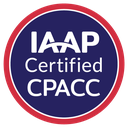
CPACC certified.
This site is my work sample
Everything here is built to the standard I hold clients to: semantic HTML, keyboard-operable, screen-reader tested, visible focus, real contrast. On the last independent check: zero automated WCAG 2.2 AA violations across every page of this site, and every text color pair at 7.8:1 contrast or better. Read the accessibility statement.
Start a conversation
Tell me what you're building or what's broken, and I'll tell you honestly whether I'm the right person for it. What happens next: I reply with either a scoping question or a straight "not me, but try this."